A First for Ergon Asia: Interns Gain International Experience

At Ergon, we are dedicated to investing in future leaders. Through interactive, hands-on engagement, we aim to provide opportunities that help students gain invaluable knowledge and develop expertise for their professional careers. 

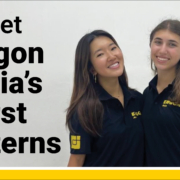
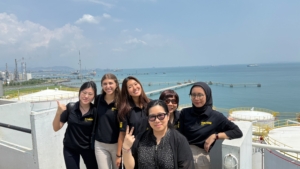
Ergon Asia hosted the first class of interns in April 2026 as part of an eight-week internship program. This opportunity allowed two students to learn about our operations, processes and companies around the world. We appreciate our interns’ commitment to gaining real-world experience and connecting with industry professionals. 

An Opportunity Like No Other 

As Rhyan Plumlee, Vice President – Sales, noted, Ergon partners with Global Academic Ventures (GAV) to help bring study abroad opportunities to students around the world. GAV assists applicants by connecting them with companies, interviews and learning opportunities. They reached out to see if Ergon Asia would be interested in hosting interns 

For Hope Rosen and Jozelyn Chen, Ergon Asia’s first two interns, it was an opportunity they simply couldn’t pass up. 

“Being one of the first interns here is really cool because everyone here is just so kind and so sweet,” Hope said gleefully. 

The New Jersey native and junior at Elon University, studying supply chain management and economic consulting, shared that the opportunity stood out from the beginning. “The employees were so welcoming, and it seemed like they had exciting projects in store for us. I feel like we’ve been able to work on a lot of interesting and insightful projects,” Hope said. 

Hailing from Long Island, New York, Jozelyn Chen, a senior at Bucknell University majoring in accounting with a minor in Chinese, shared similar sentiments. 

“Ergon was one of the only companies that asked me, ‘How did this impact your life? How did studying abroad previously impact your personal and professional career?’ Jozelyn shared. “Being the only company that asked me those questions, I felt a warm presence from them. They wanted to get to know me and work with me. But this was an interactive experience, too. I would get to work with a company and integrate myself within their operations, which was what I wanted.” 

And they did just that. 

________________
________________

The first day started with in-depth research into Ergon’s history, operations and functions. 

“I learned how operations worked in the oil industry, especially transformer oils. I also learned about supply chain management, along with demand and forecasting,” Hope noted.

Then it was time to take it up a notch. 

“For demand planning, I was able to work on projects analyzing incoterms and free trade agreements (FTAs). Jozelyn and I worked on that together. Another thing I’ve been doing is creating a weekly newsletter, updating everyone on what’s currently happening in the supply chain,” she continued.  

Jozelyn loved having the opportunity to gain additional finance experience and expand her horizons outside her comfort zone. She also participated in acquisition target analysis and researching companies.

________________
________________

Home Away From Home 

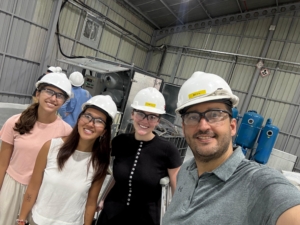
Thousands of miles from home, Ergon’s family-like culture created a familiar feeling. From sitting in on meetings and listening to the Ergon Asia team collaborate, Hope and Jozelyn said they were fully integrated into project planning, forecasting and team bonding activities. 

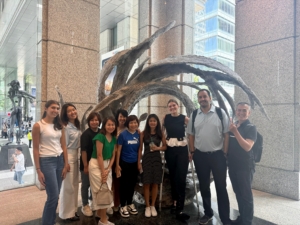
“A bunch of people from the office all went on a bike ride together at one of the parks, and then we went out for seafood afterward. It was fun getting to bond. When it was my birthday, everyone surprised me with a cake. When they say the Ergon culture is like family, I feel like it truly is because everyone just bonds together, and the environment is just so great,” Hope reflected. 

Jozelyn added, “It shows a lot of their dedication to helping us grow and helping us learn. They took the time to meet with me and talk through my projects and what they do. It was really helpful, too.” 

________________
________________

Looking Ahead to the Future 

As their internship with Ergon Asia approached its final week, each took home an invaluable experience that will guide them in their career paths. 

“One thing that I’ll definitely apply to my career journey is finding an environment that mirrors Ergon,” Jozelyn said. “Also, working with so many of the financial aspects and interpreting and researching finances for Ergon broadened my horizons into looking beyond accounting and exploring what else I could do outside of typical industries.” 

“I’ve learned what type of leadership I want to look up to and what type of leader I would potentially want to become one day. I learned a lot more about global shipping and truly how current events impact everyday supply chain activities,” Hope added. 

After wrapping up their experience as Ergon Asia’s first interns, they shared a piece of advice for students interested in studying abroad: Take advantage of every opportunity, learn the ropes and connect with your team members. We remain committed to investing in future generations so they, too, can not only learn about our organization, but become leaders across several fields in our industry.

________________
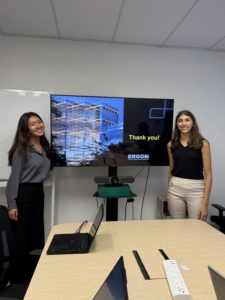
Good luck, Hope and Jozelyn!

________________
Run It Like You Own It

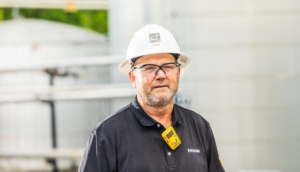
After nearly 50 years at Ergon’s Knoxville terminal, Charlie Lynch reflects on the people, passion and responsibilities that defined his career. 


For five decades, Charles ‘Charlie’ Lynch has walked Ergon’s Knoxville terminal like someone tending to a home. 

He notices everything: a piece of paper near the loading rack. A handrail that needs a fresh coat of yellow paint. A strange sound coming from a pump in the middle of the night.  

Even after decades at the terminal — and years spent managing it — no job is too small for Lynch. 

“I’m not going to ask my guys to do something that I wouldn’t do or couldn’t do,” Lynch said. “If they’re busy and I need trucks loaded, I’m loading trucks.” 

That mindset has shaped both Lynch’s career and the culture of the Knoxville terminal itself — a small but busy terminal tucked along the Tennessee River that has consistently evolved alongside the industry. 

________________

________________

Doing Whatever Needs Doing 

When Lynch first arrived at the Knoxville terminal in 1977, the operation looked much different than it does today. At the time, the facility was owned by the Krug family, who had started the company in 1954 — the same year Leslie Lampton Sr. founded Ergon. 

Lynch began as a terminal operator, loading trucks, filling tanks and helping maintain equipment during long weeks that often stretched into weekends. 

“You did everything,” Lynch said. “Whatever had to be done, we did.” 

Over the years, he learned every corner of the operation, from electrical work to heat tracing, general maintenance, loading operations and quality control. Eventually, he worked his way up from operator to assistant manager. In June 2007, Lynch took on the role of Terminal Manager — which he’s held ever since. 

His hands-on experience became one of the Knoxville terminal’s defining strengths. 

“If they call me in the middle of the night and tell me something’s wrong at panel seven or on a tank, I know exactly what they’re talking about,” Lynch said. “Experience is the world’s greatest teacher.” 

Today, the Knoxville terminal sits on roughly 16 acres and stores asphalt products delivered primarily by barge before being loaded onto trucks and shipped throughout the region. The facility includes 15 tanks with approximately 200,000 barrels of storage capacity. But ask Lynch what matters most about the operation, and his answer has little to do with numbers. 

“Obviously, we want to do right by our customers and their products,” said Lynch. “But our number one priority is safety. And if we’re staying safe, that naturally means we’re doing a good job for those customers.” 

Raising the Safety Standard 

Safety has long been a priority at the terminal, and that focus was further strengthened after Ergon acquired the facility in 2007.  

Lynch admits the transition initially brought uncertainty. Like many employees who have experienced acquisitions in the industry, he wondered what changes might come. But he trusted the judgment of former owner Jim Krug, who believed Ergon was the right fit. 

“When Mr. Lampton talked to him, that was it. Mr. Krug knew who to sell it to,” Lynch said. “And he sold it to the right person.” 

What followed was a transformation in training, safety systems and operational support that left a lasting impression on Lynch. 

“I was really impressed by Ergon’s commitment to safety and training,” said Lynch. “They brought in people from across the organization — I’d never seen such a comprehensive safety training program. I was all for it, because at the end of the day, we want everybody to go home like they came to work.” 

Over time, that philosophy became deeply embedded in the terminal’s culture. Lynch speaks about safety less as a requirement and more as a responsibility — something built through repetition, mentorship and ownership. 

“Safety is a way of life,” he said. “It’s not something you just think about. You have to live it.” 

Pride in the Details 

That same sense of ownership shows up everywhere around the Knoxville terminal. 

The facility is known for its clean appearance, bright yellow handrails and meticulous housekeeping — details Lynch insists matter just as much as production numbers.  

To Lynch, housekeeping is about more than appearance. A clean terminal signals discipline, professionalism and respect for the people who work there and visit the site every day. 

“We take a lot of pride in maintaining our facility,” said Lynch. “We do our best to keep it spotless. Doesn’t matter how old our terminal is or what we’re storing, I want it looking nice, and I want it to stay that way.” 

Relationships Matter 

The Knoxville terminal also maintains close relationships with local firefighters, police officers and emergency response teams. Lynch regularly invites them onsite for tours and training exercises so they understand the facility long before an emergency could ever happen. 

“We want them to know what they’re coming into,” said Lynch. “We prioritize safety, but if something were to happen, we want to make sure there’s no confusion on site.” 

Equally as important to Lynch are the relationships built with the truck drivers and customers who pass through the terminal each day. 

“Every truck driver that comes through that gate is my boss,” said Lynch. “If they don’t show up, I don’t have a job. It’s as simple as that.” 

Lynch knows many of them by name. He asks about their families and helps them when their trucks break down. To him, customer service is not separate from the work — it is the work. 

“Treat people good and they’ll come back,” said Lynch. “You show them you appreciate them, thank them for doing their job and be there to help them when they need help. It makes your life easier, and it’s just the right thing to do.” 

More Than a Workplace 

One of Lynch’s clearest memories from the transition to Ergon came shortly after the acquisition, when Mr. Lampton visited Knoxville and took employees and their spouses out to dinner. 

“Mr. Lampton really impressed me when he came up here and took all of us to the nicest restaurant in Knoxville,” said Lynch. “We had a great meal, and before he spoke, he went around to every table, introduced himself and spent time talking with all of us and our wives. He wanted everyone to feel included and informed, and that went a long way so early in the acquisition.” 

To Lynch, moments like that reinforced something he had already begun to believe — that despite the changes happening around the terminal, the company still valued relationships and people. 

“It just got better,” Lynch said of the transition. “It empowered us, and we felt more responsible to take ownership.” 

That mentality became one of the defining principles of Lynch’s career. 

“They told me to run it like I own it,” said Lynch. “And that’s what I’ve always tried to do.” 

Charlie’s Next Chapter 

After nearly five decades at the Knoxville terminal, Lynch now looks toward retirement with the same hands-on mindset that defined his career. When asked about his plans, Lynch already had everything figured out. 

“I’m really looking forward to spending time with my wife, first and foremost. Being home more often is going to be a blessing. And, I’ll enjoy playing with my street rods,” he said. “I buy and refurbish older models in a shop I built myself. That’ll be fun, and I’m excited to have the time to teach my grandkids about cars.” 

As Lynch prepares for retirement, he reflects on his time at the Knoxville terminal with gratitude.  

“I thank God for it,” said Lynch. “It gave me a good job to raise my kids and grandkids. And Mr. Lampton always treated me like I was somebody — not just a number.” 

The terminal changed over the years. The industry has changed, too. However, the mindset Charlie Lynch brought to the job never did: Take care of your people, take pride in the work and leave things better than you found them.  

The Advantage of Flexibility in Logistics

Read Executive Vice President – Integrated Services & Logistics Joel Pastorek‘s latest LinkedIn article, as shown below, sharing why flexibility is so important in the logistics industry.

________________

It’s easy to overlook logistics when everything is working the way that it should. 

Most people don’t realize how much of daily life depends on it. Goods don’t simply show up where they’re needed. They are moved, stored, coordinated and delivered by people doing work that is often out of sight, but always required. 

But when it’s not working, you notice it quickly. Businesses, communities, families and individuals feel it when something they rely on doesn’t show up when it should.  

Efficiency has always been the focus in logistics, and for good reason. But at some point, efficiency alone isn’t enough. Systems have to be able to adjust when conditions change. That’s where flexibility starts to matter, and where it has to work alongside efficiency. 

And when it comes to customers, their needs shift. Markets move. Disruptions happen, sometimes without much warning. When they do, the questions become straightforward: Can your business still deliver, and can your customers count on you? 

Not in Theory — In Practice 

Flexibility shows up in how the work is built. 

Some companies don’t focus on flexibility until something breaks. A supplier changes, a route is disrupted or demand shifts faster than expected. At that point, flexibility isn’t a strategy, it determines whether you are viable and have another way forward. 

For logistics providers, that often comes down to how diversified and connected the network really is — not on paper, but in practice. 

For Ergon, that shows up in how our companies operate together. Storage, transportation and coordination aren’t separate efforts. They are tied to each other. 

Across terminals and through assets like trucks, rail, pipelines, barges and marine vessels, the focus stays the same: move product safely, on time and on spec. The equipment is only part of the equation. 

Behind the equipment is a whole operation of people managing the details — planning routes, making adjustments, coordinating across teams and making sure each step lines up with the next. It’s not always easy, but it’s what keeps things moving when conditions aren’t ideal. 

That structure creates options. When conditions change, you need them. 

More Than One Way to Deliver 

The same idea applies outside of logistics. 

Some businesses have a core focus, and that matters. But relying on a single path or way of operating can create risk. Diversification gives you more than one way to meet customer needs when conditions change. Diversification can come from various modes of transportation services, but it can also come from scale. Scale can allow you to pull resources from numerous locations on short notice in emergency situations. This became critical for our Ergon team in March as the Iran conflict caused panic buying and constrained rail availability. We were able to pull from our diverse locations to meet the needs of our customers in the regions most impacted by this market volatility.   

It was good to have those options, but having options isn’t enough on its own. 

Managing them well is what makes the difference. Clarity, coordination and accountability determine whether a network actually performs the way it should. Without that, added capability can turn into unnecessary complexity. 

When it’s working, customers don’t see the moving parts. What they see is consistency. They know what to expect, even when conditions aren’t steady. 

In those environments, consistency matters. 

What Holds 

Flexibility isn’t something you create in the moment. It’s built strategically ahead of time — in how systems are designed, how teams operate and how decisions are made. 

It’s also about the people like drivers, operators, dispatchers, planners and others who keep things moving every day. 

Their work is often behind the scenes, but the impact isn’t. 

If you have the opportunity, take a moment to thank someone in logistics. There’s a good chance their work played a role in something you relied on today.