
After nearly 50 years at Ergon’s Knoxville terminal, Charlie Lynch reflects on the people, passion and responsibilities that defined his career.
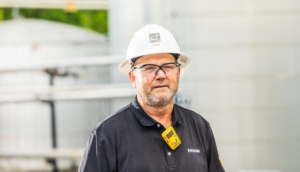
For five decades, Charles ‘Charlie’ Lynch has walked Ergon’s Knoxville terminal like someone tending to a home.
He notices everything: a piece of paper near the loading rack. A handrail that needs a fresh coat of yellow paint. A strange sound coming from a pump in the middle of the night.
Even after decades at the terminal — and years spent managing it — no job is too small for Lynch.
“I’m not going to ask my guys to do something that I wouldn’t do or couldn’t do,” Lynch said. “If they’re busy and I need trucks loaded, I’m loading trucks.”
That mindset has shaped both Lynch’s career and the culture of the Knoxville terminal itself — a small but busy terminal tucked along the Tennessee River that has consistently evolved alongside the industry.
________________
________________
Doing Whatever Needs Doing
When Lynch first arrived at the Knoxville terminal in 1977, the operation looked much different than it does today. At the time, the facility was owned by the Krug family, who had started the company in 1954 — the same year Leslie Lampton Sr. founded Ergon.
Lynch began as a terminal operator, loading trucks, filling tanks and helping maintain equipment during long weeks that often stretched into weekends.
“You did everything,” Lynch said. “Whatever had to be done, we did.”
Over the years, he learned every corner of the operation, from electrical work to heat tracing, general maintenance, loading operations and quality control. Eventually, he worked his way up from operator to assistant manager. In June 2007, Lynch took on the role of Terminal Manager — which he’s held ever since.
His hands-on experience became one of the Knoxville terminal’s defining strengths.
“If they call me in the middle of the night and tell me something’s wrong at panel seven or on a tank, I know exactly what they’re talking about,” Lynch said. “Experience is the world’s greatest teacher.”
Today, the Knoxville terminal sits on roughly 16 acres and stores asphalt products delivered primarily by barge before being loaded onto trucks and shipped throughout the region. The facility includes 15 tanks with approximately 200,000 barrels of storage capacity. But ask Lynch what matters most about the operation, and his answer has little to do with numbers.
“Obviously, we want to do right by our customers and their products,” said Lynch. “But our number one priority is safety. And if we’re staying safe, that naturally means we’re doing a good job for those customers.”
Raising the Safety Standard
Safety has long been a priority at the terminal, and that focus was further strengthened after Ergon acquired the facility in 2007.
Lynch admits the transition initially brought uncertainty. Like many employees who have experienced acquisitions in the industry, he wondered what changes might come. But he trusted the judgment of former owner Jim Krug, who believed Ergon was the right fit.
“When Mr. Lampton talked to him, that was it. Mr. Krug knew who to sell it to,” Lynch said. “And he sold it to the right person.”
What followed was a transformation in training, safety systems and operational support that left a lasting impression on Lynch.
“I was really impressed by Ergon’s commitment to safety and training,” said Lynch. “They brought in people from across the organization — I’d never seen such a comprehensive safety training program. I was all for it, because at the end of the day, we want everybody to go home like they came to work.”
Over time, that philosophy became deeply embedded in the terminal’s culture. Lynch speaks about safety less as a requirement and more as a responsibility — something built through repetition, mentorship and ownership.
“Safety is a way of life,” he said. “It’s not something you just think about. You have to live it.”
Pride in the Details
That same sense of ownership shows up everywhere around the Knoxville terminal.
The facility is known for its clean appearance, bright yellow handrails and meticulous housekeeping — details Lynch insists matter just as much as production numbers.
To Lynch, housekeeping is about more than appearance. A clean terminal signals discipline, professionalism and respect for the people who work there and visit the site every day.
“We take a lot of pride in maintaining our facility,” said Lynch. “We do our best to keep it spotless. Doesn’t matter how old our terminal is or what we’re storing, I want it looking nice, and I want it to stay that way.”
Relationships Matter
The Knoxville terminal also maintains close relationships with local firefighters, police officers and emergency response teams. Lynch regularly invites them onsite for tours and training exercises so they understand the facility long before an emergency could ever happen.
“We want them to know what they’re coming into,” said Lynch. “We prioritize safety, but if something were to happen, we want to make sure there’s no confusion on site.”
Equally as important to Lynch are the relationships built with the truck drivers and customers who pass through the terminal each day.
“Every truck driver that comes through that gate is my boss,” said Lynch. “If they don’t show up, I don’t have a job. It’s as simple as that.”
Lynch knows many of them by name. He asks about their families and helps them when their trucks break down. To him, customer service is not separate from the work — it is the work.
“Treat people good and they’ll come back,” said Lynch. “You show them you appreciate them, thank them for doing their job and be there to help them when they need help. It makes your life easier, and it’s just the right thing to do.”
More Than a Workplace
One of Lynch’s clearest memories from the transition to Ergon came shortly after the acquisition, when Mr. Lampton visited Knoxville and took employees and their spouses out to dinner.
“Mr. Lampton really impressed me when he came up here and took all of us to the nicest restaurant in Knoxville,” said Lynch. “We had a great meal, and before he spoke, he went around to every table, introduced himself and spent time talking with all of us and our wives. He wanted everyone to feel included and informed, and that went a long way so early in the acquisition.”
To Lynch, moments like that reinforced something he had already begun to believe — that despite the changes happening around the terminal, the company still valued relationships and people.
“It just got better,” Lynch said of the transition. “It empowered us, and we felt more responsible to take ownership.”
That mentality became one of the defining principles of Lynch’s career.
“They told me to run it like I own it,” said Lynch. “And that’s what I’ve always tried to do.”
Charlie’s Next Chapter
After nearly five decades at the Knoxville terminal, Lynch now looks toward retirement with the same hands-on mindset that defined his career. When asked about his plans, Lynch already had everything figured out.
“I’m really looking forward to spending time with my wife, first and foremost. Being home more often is going to be a blessing. And, I’ll enjoy playing with my street rods,” he said. “I buy and refurbish older models in a shop I built myself. That’ll be fun, and I’m excited to have the time to teach my grandkids about cars.”
As Lynch prepares for retirement, he reflects on his time at the Knoxville terminal with gratitude.
“I thank God for it,” said Lynch. “It gave me a good job to raise my kids and grandkids. And Mr. Lampton always treated me like I was somebody — not just a number.”
The terminal changed over the years. The industry has changed, too. However, the mindset Charlie Lynch brought to the job never did: Take care of your people, take pride in the work and leave things better than you found them.